
Bali, August 2026
Aquaculture is entering a period in which producing more is no longer enough. Rising production costs, volatile feed commodity markets, tighter margins, disease risks and climate pressures are forcing the industry to reconsider one of its most fundamental inputs: feed.
That was the central message emerging from TARS 2026 – Aquafeeds: Fit for Future 2.0, held on 19–20 August at The Westin Resort Nusa Dua, Bali, Indonesia.
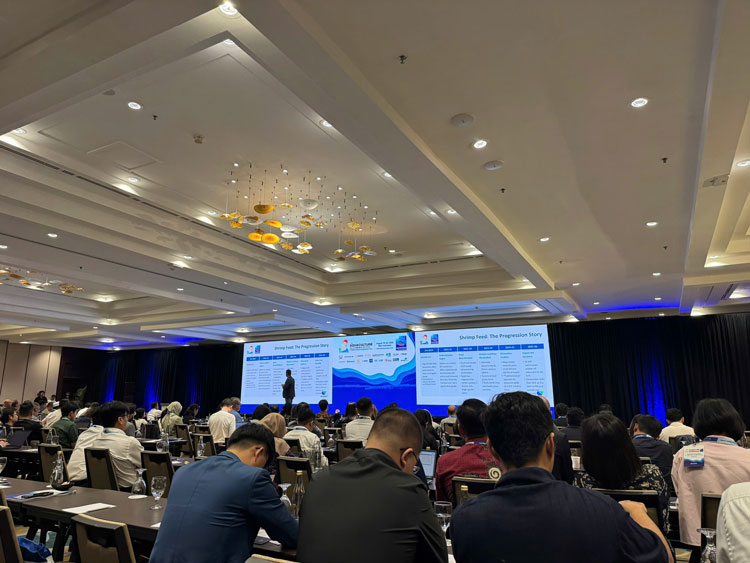
Now in its 15th year, The Aquaculture Roundtable Series (TARS) has established itself as a platform for strategic dialogue across Asia’s aquaculture value chain. Unlike conventional conferences, TARS places particular emphasis on interaction between feed manufacturers, farmers, nutritionists, technology providers, researchers and business leaders.
This year, that format was particularly relevant.
The discussions in Bali suggested that the future of aquafeeds will not be determined by feed formulation alone. Instead, the next generation of aquafeeds will increasingly sit at the intersection of precision nutrition, animal health, farm data, automation, alternative ingredients, sustainability and economics.
From “better feed” to “fit-for-purpose feed”
One of the strongest messages from TARS 2026 was the need to move beyond the traditional concept of a general-purpose feed.
The conference opened with a discussion of the structural pressures facing the aquafeed industry, including volatile commodity prices, supply disruptions, rising production costs and narrowing margins. For farmers, however, feed cost cannot be evaluated simply by the price of a kilogram of feed.The more meaningful question is how efficiently that feed is converted into biomass. This is where precision nutrition becomes increasingly important.
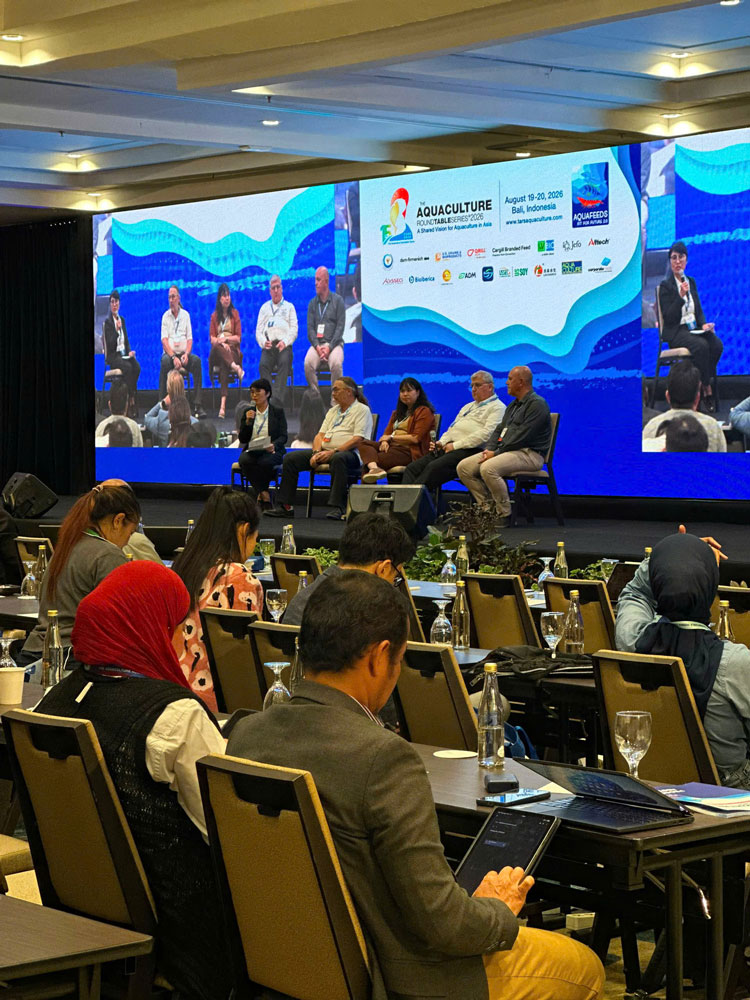
Sessions on digestible nutrient-based formulation highlighted the importance of matching nutrient availability and pellet characteristics to species, size and life stage. The objective is not simply to formulate nutritionally adequate feeds, but to achieve the lowest feed cost per kilogram of weight gain while maintaining animal performance. This represents a significant shift in thinking. The industry is moving from:
“ How much does the feed cost? ” towards: “ What does the feed deliver? ”. For Asian aquaculture, where feed represents one of the largest operating costs in intensive production systems, that distinction could have major implications.
Functional feeds: nutrition meets health
Perhaps one of the most important developments discussed at TARS 2026 was the growing convergence between nutrition and health management. The session on Risk Management, Health & Functional Feeds explored how functional ingredients can support resilience against stress, environmental fluctuations and disease challenges, while contributing to immunity, gut health and microbiome balance.
The message is particularly relevant to shrimp farming. In high-intensity production systems, nutrition cannot be separated from animal health. A feed that supports growth but performs poorly under environmental or disease stress may ultimately deliver inferior economics. Vietnamese expertise featured prominently in this discussion.
Loc Tran, Founder & Director of ShrimpVet Laboratory and Founder & CEO of EcoSeafood Group, presented on functional ingredients in aquafeeds for risk and health management. His participation reflected the increasingly important role of Vietnamese technical expertise in the regional shrimp health and nutrition conversation.
The broader implication is clear: functional feed is moving from a niche concept towards a more integrated component of farm risk management.
Vietnam: increasingly visible across the aquafeed value chain
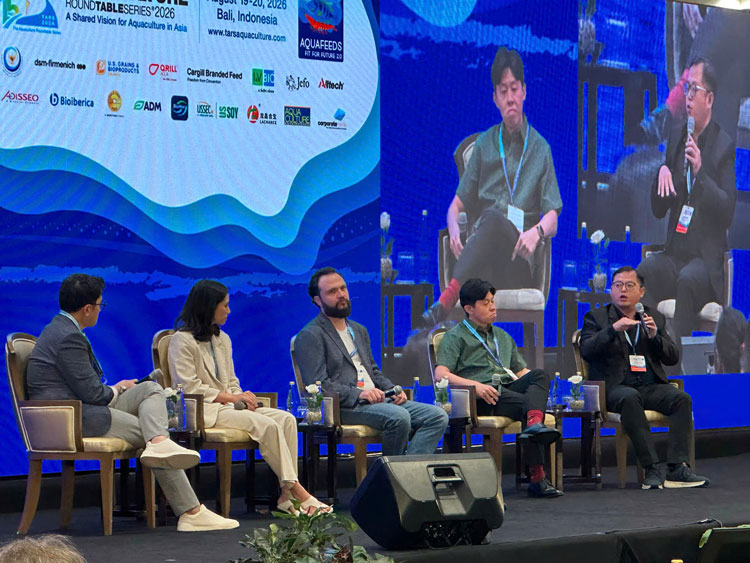
Vietnamese representatives were present not only as participants from multinational feed companies, but across several different parts of the aquaculture ecosystem. The speaker list included representatives from Royal De Heus Vietnam, BioMar Group Vietnam, ADM Animal Nutrition Vietnam, Uni-President Vietnam, ShrimpVet Laboratory and EcoSeafood Group, and Good Tôm. This diversity is significant.
It demonstrates that Vietnam’s position in Asian aquaculture is evolving beyond its traditional identity as a major shrimp and pangasius producer.
Vietnamese professionals are increasingly involved in:
• aquaculture nutrition;
• feed additives and formulation;
• shrimp health;
• precision farming;
• sustainable production; and
• technology-driven farm management.
During the Industry Dialogue between next-generation farmers and feedmillers, Chewen Wei of Uni-President Vietnam and Dragoș Mircea of Good Tôm Vietnam joined representatives from Indonesia and Thailand to discuss what the next generation of farmers expects from feed manufacturers. That dialogue was particularly revealing. The emerging farmer generation is increasingly demanding not simply feed supply, but measurable results: feed efficiency, profitability, technical support, environmental responsibility and greater use of science, technology and data.
That expectation will increasingly shape the relationship between feedmillers and farmers in Vietnam as well.
From feed management to smart feeding
Technology was another major theme running through TARS 2026. The Smart Feeding & Management session examined how real-time biomass information, AI-driven monitoring, acoustic autofeeders, auto-siphons and plankton diagnostics can improve feeding decisions. The goal is straightforward: reduce waste and improve FCR through more precise nutrient delivery. But the deeper change is technological. For decades, feeding decisions on many farms have depended heavily on farmer experience and observation. The emerging model combines that experience with continuous data.
Farmers can increasingly monitor: biomass → behaviour → environmental conditions → feeding response → feed consumption → growth → FCR. This creates the foundation for a more adaptive production system. The implications for Vietnam are substantial. The Mekong Delta, in particular, has millions of small and medium-scale production decisions being made across highly diverse farming environments. The challenge is not simply developing sophisticated technology, but making technology sufficiently affordable, robust and practical to work under real farm conditions.
The alternative ingredient question is changing
Another important theme was the discussion around alternative feed ingredients. For years, the alternative protein conversation has largely been framed around one question: Can this ingredient replace fishmeal or another conventional protein source? TARS 2026 suggested that the industry is asking a more sophisticated question. Can an alternative ingredient provide functional value as well as nutritional value? Sessions on alternative ingredients examined developments including insect-derived proteins and single-cell proteins, while also addressing the challenge of creating sufficient market demand for adoption. This distinction matters. If an alternative ingredient is evaluated purely as a cheaper substitute, adoption will depend heavily on commodity economics.
If it can demonstrate additional benefits — such as improved digestibility, gut health, resilience or feed performance — its value proposition becomes much stronger. This could become one of the defining areas of aquafeed innovation over the next decade.
Sustainability is becoming measurable
Sustainability was another major thread running through the second day of TARS 2026. But again, the conversation has evolved. Rather than treating sustainability as a separate corporate objective, the conference increasingly connected it with feed efficiency, life-cycle assessment, ingredient selection and farm performance.
The session “Feed Sustainability & Technology: Fit for Future” examined how life-cycle assessment, data-led feed management and performance-enhancing technologies can contribute to reducing environmental impact. This is an important development for export-oriented aquaculture industries such as Vietnam.
As international markets increasingly ask where ingredients come from, how products are produced and what their environmental footprint is, sustainability will become increasingly connected to market access. The most sustainable feed may ultimately not be the feed with the lowest environmental footprint per kilogram of ingredient. It may be the feed that produces the best biological and economic output with the lowest overall environmental impact per kilogram of farmed seafood.
The bigger question: who will pay for innovation?
Perhaps the most interesting question emerging from TARS 2026 was not technical. It was economic.
The industry already has access to a growing range of technologies, functional ingredients, alternative proteins, precision nutrition tools and digital farming solutions. But adoption depends on one fundamental issue: Can these innovations create measurable value for farmers? This question was explicitly addressed during the conference’s Hard Talk with C-Suite Business Leaders and the interactive roundtable sessions, where participants discussed what needs to change in aquafeeds and feeding and what a genuinely “fit for future” feed should look like. For feed companies, this means developing products that can demonstrate return on investment. For farmers, it means becoming more data-driven in evaluating feed performance. For technology companies, it means developing solutions that work under real production conditions rather than only in controlled environments.
And for the industry as a whole, it means creating stronger collaboration between the different parts of the value chain.
What TARS 2026 means for Vietnam
From a Vietnamese perspective, the most important takeaway from Bali may be that the country already possesses many of the ingredients required for the next stage of aquaculture development. Vietnam has a large production base, extensive farming experience, a sophisticated processing and export industry, strong technical expertise and an increasingly active ecosystem of feed, health and technology companies.
The challenge is to connect these assets. Vietnam’s next competitive advantage may not come simply from producing more shrimp or fish. It could come from producing more efficiently, more predictably and with better data. That means moving towards a model in which: Nutrition + Health + Data + Technology + Farm Management + Sustainability = Farm Performance
Such a transition would require stronger collaboration between farmers, feedmillers, researchers, technology companies, processors and policymakers. It would also require greater willingness to share data and convert farm experience into scalable knowledge.
From “Fit for Future” to “Fit for Reality”
TARS 2026 was positioned as the next stage following the original “Aquafeeds: Fit for Future” discussion held in 2019. Five years later, the question has become more urgent. Aquaculture does not simply need feeds that are technologically advanced. It needs feeds that are economically viable, biologically effective, environmentally responsible and adaptable to increasingly complex farming conditions. That may ultimately be the most important meaning of “Fit for Future 2.0”. The future of aquafeeds will not be defined by one ingredient, one technology or one company.
It will be defined by how effectively the industry connects nutrition, health, data, technology and economics into a system that works at farm level. For Vietnam, that transition represents both a challenge and an opportunity. The country is already an important part of Asia’s aquaculture value chain. The next question is whether Vietnam can become not only a major producer, but also a source of innovation for the future of Asian aquaculture.