
According to VASEP (the Vietnam Association of Seafood Exporters and Producers), seafood export of Vietnam turnover in August 2026 reached 1.14 billion USD, up 6.4% year-on-year. Accordingly, cumulative exports for the first eight months of 2026 surpassed 8 billion USD, an increase of 11.9%.
Export turnover remained above the 1 billion USD/month threshold; however, the growth rate in August was only about half the cumulative eight-month expansion pace. This indicates that performance in the first eight months was largely buoyed by strong momentum in preceding months.
Shrimp remained the largest export commodity, reaching nearly 479 million USD in August and close to 3.28 billion USD over eight months. Pangasius generated nearly 205 million USD in August and 1.52 billion USD cumulatively. Tuna, squid, and octopus continued to grow, though at a decelerating pace. Crabs and other crustaceans stood out, surging 50.2% in August and 34.1% over eight months, though their scale remains too small to determine overall sector trends.
The top five export destinations for Vietnamese seafood during the first eight months of 2026 comprised China and Hong Kong at over 2 billion USD; the United States at nearly 1.26 billion USD; Japan at nearly 1.12 billion USD; South Korea at 565 million USD; and Australia at 252 million USD.

VASEP: Priority for seafood export is not merely having more orders.
Ms. Le Hang, Deputy Secretary General of VASEP, noted that the United States represents the single largest variable for Vietnamese seafood exports in the last three months of the year as this market introduces numerous compounding hurdles.
Effective July 24, 2026, multiple Vietnamese seafood lines face an additional Section 301 tariff of 12.5%. This levy is stacked on top of Most-Favored-Nation rates and, depending on the product line or exporter, may also be compounded by antidumping and countervailing duties. As a result, the landed cost to importers increases by far more than 12.5%, absorbing a substantially heavier multi-tiered tariff burden.
For pangasius, the final results of the 21st administrative review (POR21) on the antidumping duty order on frozen pangasius and basa from Vietnam, covering the review period from August 1, 2023, to July 31, 2024, were released on August 12 with duty margins less favorable than preliminary findings, exerting direct pressure on price quotations and supplier selection.
For shrimp, final determinations in the antidumping duty administrative review are slated for announcement in early November. This falls relatively late for the peak year-end holiday procurement cycle, forcing exporters and importers to structure contracts without complete clarity on total customs liability. Should final duty rates rise sharply, finalized sales contracts could trigger disputes regarding pricing adjustments, cost sharing, or delivery schedules.
Beyond tariff barriers, seafood shipments bound for the US market face stringent scrutiny under the Marine Mammal Protection Act (MMPA), Certificate of Admissibility (COA) mandates for select tariff lines, forced labor oversight, food safety inspections, and an intensified enforcement posture by US Customs and Border Protection (CBP). Stricter regulatory proposals concerning veterinary antibiotic residues in imported seafood also warrant close tracking, even though not all have been formally enacted into law.
Ms. Le Hang projected that the full-year export target of roughly 12 billion USD in 2026 remains attainable if the remaining four months sustain an average run-rate of nearly 1 billion USD per month. However, deceleration risks are mounting, particularly if US consumer purchasing power fails to rebound, if early November shrimp duty outcomes prove adverse, or if documentation delays under IUU and MMPA requirements continue to hinder customs clearance.

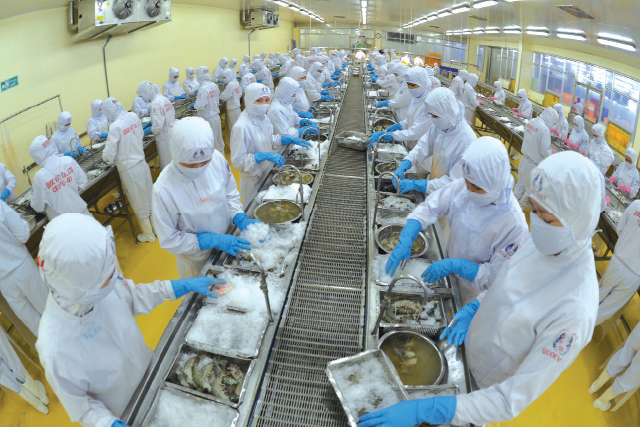
Shrimp remained Vietnam’s largest seafood export commodity in the first eight months of 2026, generating nearly 3.28 billion USD. Photo: Thanh Cuong.
According to Ms. Hang, enterprises shipping to the US market must calculate total composite tax liabilities broken down by specific product lines and legal entities, rather than relying on a blended average duty rate across business plans. Sales contracts should clearly stipulate party obligations under tariff shifts, exact tax assessment timelines, price renegotiation clauses, and burden-sharing mechanisms for incidental expenses.
For shrimp, companies must formulate at least two operational scenarios ahead of the early November findings while curbing inventory hoarding without firm off-take commitments. For pangasius, processors should accelerate diversification toward the EU, the Middle East, ASEAN, and alternative whitefish market segments. For marine capture fisheries, IUU certifications, MMPA documentation, and traceability dossiers must be strictly validated right from raw material procurement.
Ms. Hang cautioned that amid escalating raw material prices, feed expenses, and regulatory compliance outlays, chasing gross export turnover through aggressive price-cutting will transmit market volatility directly into enterprise balance sheets. The overarching priority for the last three months of the year is therefore not merely securing additional purchase orders, but selectively taking on contracts where tariffs, documentation compliance, trade receivables, and operating margins can be rigorously controlled.
Translated by Ha Chi