
With more than 4,600 hectares of aquaculture water surface, Ha Tinh has long relied on traditional cultured species that generate relatively modest economic returns. In this context, the introduction of freshwater pearl farming is emerging as a promising alternative, improving water-use efficiency while enabling the sustainable utilisation of native resources.
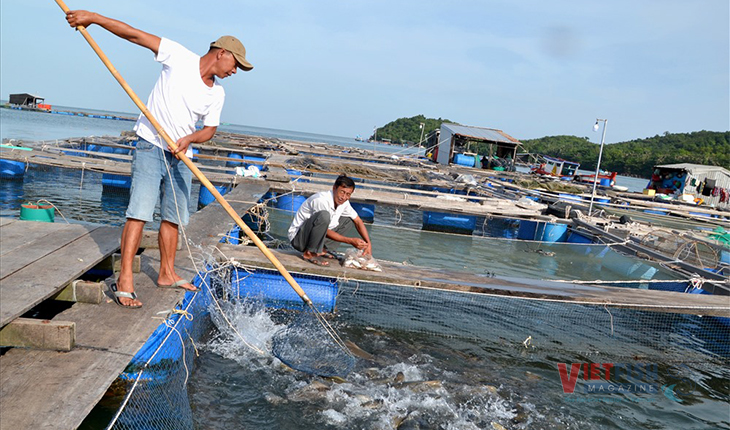
The project titled “Application of scientific and technological advances to develop a broodstock selection and freshwater pearl farming model in Ha Tinh city” has been implemented from October 2023 to March 2026 on a 2-hectare scale. Led by the Ha Tinh Agricultural Extension Center in collaboration with private sector partners, the model has been equipped with an integrated system, including conditioning tanks, nucleus implantation facilities and suspended cage culture ponds. Environmental parameters are routinely monitored, while technical staff have undergone structured training, progressively mastering the full production cycle, from broodstock selection and nucleus implantation to husbandry.

After nearly 28 months, initial results have been highly encouraging. A total of 18,000 individuals were stocked, with survival rates across production stages meeting and exceeding technical benchmarks. After 22-24 months of culture, harvested pearls reached sizes of 7-11 mm, with thick nacre layers and a distinctive purplish lustre, meeting requirements for jewellery processing.
By the end of 2025, the first harvest yielded 12,845 pearls from 6,600 individuals, while the second harvest is expected to contribute nearly 7,000 additional pearls. Total output is projected at approximately 19,825 pearls, averaging close to two pearls per individual, generating profits exceeding VND 800 million. Notably, the production process relies entirely on natural feed sources, without the use of formulated feeds or chemicals, thereby contributing to improved pond environmental quality.
Beyond pearl production, by-products such as meat and shells are further utilised, opening up opportunities for developing an integrated value chain. The model also creates local employment and holds potential for integration with experiential tourism.
According to technical agencies, this is a novel, highly applicable model well-suited to local conditions. However, to ensure sustainable development, further refinement of technical protocols is required, alongside stricter broodstock quality control, enhanced environmental monitoring, and the establishment of value chain linkages from farming and processing to marketing, coupled with traceability systems.
With these promising initial outcomes, freshwater pearl farming is expected to become a new production direction, contributing to increased value in the aquaculture sector and diversified livelihoods for local communities in Ha Tinh.
VFM