
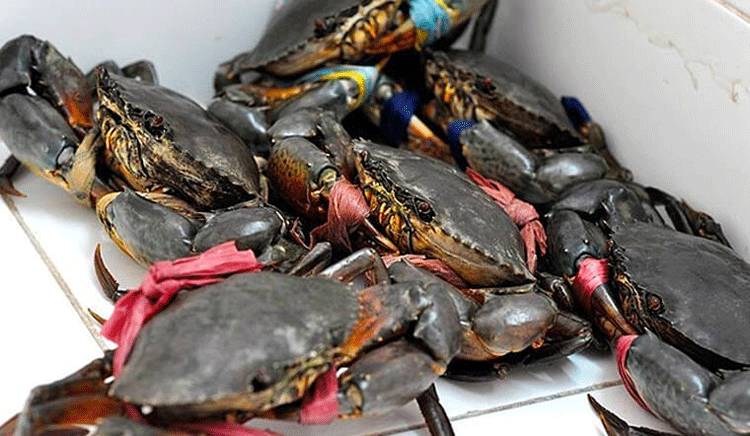
Ca Mau province is accelerating its transition toward official export channels as it works to build a more sustainable and competitive value chain for its crab sector.
According to the provincial Department of Industry and Trade, Ca Mau crab is widely regarded as a high-potential export product, but several bottlenecks continue to constrain growth. Most crab is still consumed domestically or moves informally through intermediaries.
Export activity remains heavily dependent on live, unprocessed crab with limited value addition. Cold-chain and logistics capacity, particularly for live shipments, lags behind demand, while traceability and quality-control systems are still being strengthened. In addition, the province lacks major lead firms capable of organising full value-chain linkages from farming areas to official export markets.
To support the industry, Ca Mau has launched a series of promotional and branding initiatives. These include the second Ca Mau Crab Festival held recently; participation in domestic and international trade events such as the Busan International Seafood & Fisheries Expo in early November, where Korean buyers showed strong interest in Ca Mau crab; and efforts to expand online sales via major e-commerce platforms. The province is also advancing geographical-indication (GI) protection for “Ca Mau Crab” and developing a stronger brand identity to enhance transparency and credibility in global markets.
Looking ahead, the Department of Industry and Trade has outlined five priority actions to expand trade and boost crab consumption. These include diversifying markets and distribution channels with a decisive shift toward official exports; strengthening logistics infrastructure for live seafood; accelerating digital transformation in trade promotion, including cross-border e-commerce; supporting new-generation cooperatives and farm-to-market linkage models, including partnerships under the “four-party cooperation” framework of state agencies, scientists, businesses and farmers; and working with Vietnamese trade offices abroad to organise trade missions and seafood export programmes, positioning crab as a flagship product.
Ca Mau currently has more than 360,000 hectares of integrated crab-shrimp farming, producing around 36,000 tonnes annually and supporting tens of thousands of coastal households. The sector generates an estimated USD 700 million per year for the province.
VFM