
An Giang: Breaking the deadlock on pricing and demand for giant freshwater prawns in U Minh Thuong

Giant freshwater prawn farmers in U Minh Thuong face volatile prices and uncertain demand despite thriving integrated rice-shrimp systems.
The rice-shrimp farming landscape in An Giang province covers approximately 107,000 ha, concentrated primarily in U Minh Thuong. Farmers operate integrated aquaculture systems, raising giant freshwater prawns, tiger prawns, whiteleg shrimp, and mud crabs alongside a single rice crop each year.
Advances in science and technology have stabilized brackish water aquaculture, boosting overall production. Yet, prices and market access, particularly for giant freshwater prawns remain volatile, keeping farmers’ profits below expectations.
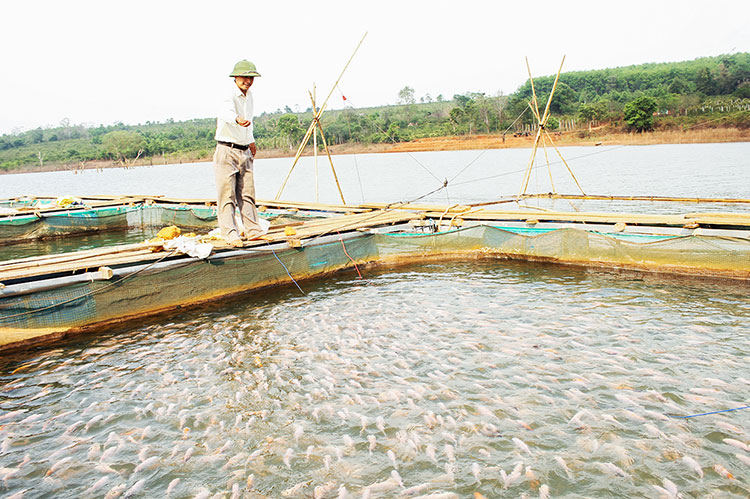
Vinh Binh commune is one of the province’s largest aquaculture hubs, with more than 12,200 ha cultivated annually and total production exceeding 85,500 tonnes, including over 61,000 tonnes of shrimp. Farmers follow organic and biosecure practices, conducting three shrimp cycles per year under local agricultural guidance.
Giant freshwater prawns are primarily fed rice, snails, and small fish, with minor commercial feed supplementation, while microbial preparations help maintain water quality. No chemical drugs are applied.
Huynh Thi Hang, from Nuoc Chay hamlet, Vinh Binh, has been farming giant freshwater prawns alongside whiteleg and tiger shrimp for over 15 years on her 2 ha farm. The integrated model provides a stable income, enabling her three children to pursue higher education and secure steady employment. Yet she notes that giant freshwater prawn prices remain unpredictable and heavily dependent on middlemen.
“Tiger and whiteleg shrimp prices are relatively stable, but giant freshwater prawns often drop sharply. Live prawns fetch 100,000-120,000 VND/kg, while stressed or dead prawns sell for 50,000-60,000 VND/kg. We hope local authorities can attract companies to guarantee buying prices around 130,000 VND/kg at the end of each cycle. That would give farmers confidence to expand production and improve livelihoods,” she said.
Nguyen Van Minh, another Vinh Binh farmer, harvested 2.2 ha of integrated shrimp this year, producing 1 tonne of giant freshwater prawns, 400 kg of whiteleg shrimp, and 200 kg of tiger prawns. Live prawns sold at 118,000 VND/kg, dead at 55,000 VND/kg, 22,000 VND lower than early 2025. “During peak harvest, middlemen often pressure prices. F
armers have little choice but to sell, frequently losing out as most buyers are local or pre-negotiated. We farm prawns under biosecure, chemical-free conditions, feeding mostly natural sources to improve taste. Still, unstable prices remain a major concern. Forming cooperatives and linking with buyers would help stabilize the market,” he explained.
Vo Thanh Xuan, Chairman of Vinh Binh People’s Council, highlighted ongoing efforts to develop a brand for “clean giant freshwater prawns.” Despite these initiatives, price volatility and uncertain market access persist. “To stabilize incomes, we focus on establishing cooperatives and strengthening value chains. Infrastructure improvements along the Cai Lon River will facilitate aquaculture transport. We also collaborate with universities and research institutes to enhance product quality and attract companies to invest in procurement and processing,” he said.
Le Huu Toan, Director of An Giang’s Department of Agriculture and Environment, said the province aims to stabilize over 117,000 ha of rice-shrimp production by 2030. The sector is restructuring along the value chain from seed and inputs to harvesting, processing, and marketing to secure sustainable profits. Measures include expanding local hatchery capacity, controlling diseases, adopting advanced and eco-friendly technologies, and developing branding and geographical indications for export markets.
From January to October 2025, aquaculture production in An Giang has remained stable with minimal disease. Total capture and farmed production reached about 1.25 million tonnes in the first ten months, with full-year projections exceeding 1.6 million tonnes. This includes over 155,000 tonnes of brackish water shrimp, nearly 649,000 tonnes of pangasius, 100,000 tonnes of cage-farmed marine fish, more than 32,000 tonnes of mud crabs, and 320,000 tonnes of other farmed species.