
Nguyen Duy Hoa, PhD.
Global Technical Director, Empyreal 75 & Motiv Products, Cargill Inc.
Tel: + 84(0)703515168 Email: duyhoa_nguyen@cargill.com
Shrimp are crustaceans that do not follow growth patterns/models of advanced animals, instead, they exhibit a stepwise (stair-step) growth model after each molt. That is also the reason why fishmeal is one of the essential protein sources for shrimp feed. Not only is fishmeal highly digestible and balanced in amino acids, but it is also rich in fatty acids and bioactive peptides, contains almost no carbohydrates or anti-nutrients, and is especially high in cholesterol—a vital precursor for synthesizing molting steroid hormones. However, under the pressure of increasing demand for fishmeal usage from animal feed industry, it is pushing fishmeal prices higher & higher while fisheries catching is limited and reducing natural biodiversity; therefore, the pressure to reduce the use of fishmeal in shrimp feed from import markets & certification organizations to meet sustainability standards is increasing. Fishmeal replacement must provide premium, digestible protein with a balanced amino acid profile, while also being rich in health nutrients, especially peptides and cholesterol to maintain nutrient balance and reduce formulation costs. This article evaluates the challenges and trends of replacing fishmeal by different fishmeal alternatives and introduces the MOTIV product – Cargill’s corn protein complex (69% protein) that provides an excellent solution for replacing fishmeal in shrimp feed.
Challenges of fishmeal alternatives
Shrimp and carnivorous fish (marine fish, trout, salmon, eel, etc.) are the species using the most fishmeal (figure 1).
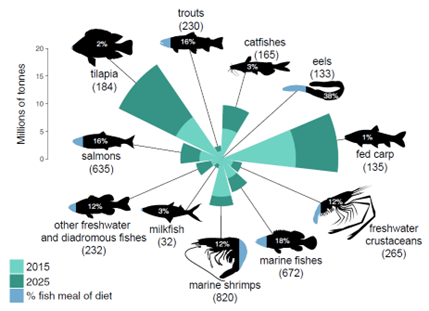
Figure 1. Fishmeal usage in different aqua species (Hua et al., 2019).
-Fishmeal is a premium protein with high attractant and palatability, balanced amino acids, rich in peptides, cholesterol, phospholipids and Omega-3 fatty acids, no anti-nutrients & carbohydrates; therefore, it addresses the nutritional requirements of the carnivorous fish species and shrimp.
-Plant-based proteins for fishmeal alternative have disadvantages, primarily the limitation of essential amino acids. For instance, methionine is limited in soybean meals, lysine is limited in corn gluten meal, and both lysine and arginine are limited in wheat gluten meal. The high carbohydrates in plant-based proteins (23-24% carbohydrates in soy proteins or 26.5-27% carbohydrates in corn gluten meal) is also limited for the carnivorous species who are using the most fishmeal. In addition, less attractive and high anti-nutrients together with the absence of cholesterol are all the big barriers of soy proteins to replace fishmeal at an inclusion higher than 5%.
-Hydrolyzed poultry-by-product meals and hydrolyzed feather meals are also viable fishmeal alternatives. However, their inclusion is limited by high ash content and less cholesterol in these fishmeal alternatives (optimal inclusion should not be higher than 5%).
-Single-cell proteins and insect meals are promising fishmeal alternatives; however, the production technologies of producing these ingredients have not yet performed the quality consistency and volume is limited to commercialized as well as really high prices are all barriers using these fishmeal alternatives for fishmeal replacement.
MOTIV – An excellent ingredient for fishmeal replacement
MOTIV – An excellent ingredient as fishmeal alternative – MOTIV is Cargill’s technical product that utilizes pure protein separation and special fermentation processes to create organic acids and bioactive peptides while increasing lysine content and other essential nutrients. Therefore, MOTIV solves the limitations found in other fishmeal-alternative protein sources mentioned above.
-MOTIV is a corn protein complex product with balanced amino acids (69% protein, high methionine and good lysine content), low in carbohydrates (1.7%) and low fiber content (< 1%), does not contain anti-nutrients, and it is, therefore; an excellent protein source for fishmeal replacement.
– MOTIV is rich in health nutrients, including organic acids (7.2%), bioactive peptides, carotenoids. Those not only help with palatability but also are good for antistress, disease resistance, and gut health.
-MOTIV is rich in phytosterols (approximately 0.6%) which is an essential element to balance cholesterol when replacing fishmeal to optimize formula costs because expensive cholesterol supplementation to balance nutrients is one of the major barriers to the other mentioned fishmeal alternatives to replace fishmeal in shrimp feed.
-MOTIV is naturally made from corn protein, so it has a much lower “carbon footprint” value than soybean sources. Shrimp respond well to MOTIV with high growth and survival rates at high doses when replacing fishmeal, up to 15%. It helps reduce pressure on natural resources and meet sustainability certification standards.
Approaches of fishmeal replacement with MOTIV
The only limitation of MOTIV when replacing fishmeal is the lack of important fatty acids although MOTIV has a high content of Omega-6 (Linoleic acid), MOTIV has almost no important fatty acids, including EPA, DHA and ARA, which are fatty acids found in fishmeal. Therefore, replacing fishmeal with MOTIV only requires combining with sustainable ingredients rich in fatty acids (such as Krill meal, seaweed or algae meal rich in Omega-3) or marine fish oil rich in Omega-3 to balance these fatty acids (EPA, DHA, ARA) as well as adding Taurine, which is an amino acid abundant in fishmeal because it plays an important role in not only being palatable but regulating the osmotic pressure for shrimp & marine fish in fluctuating salinity environment of farmed shrimp and marine fish.
Approaches of producing functional feeds with MOTIV
Because MOTIV is a highly premium protein source containing several health nutrients, it can be combined with other premium protein sources (Krill meal, high-quality fishmeal, yeast cell extract, seaweed and/or marine algae extract), organic minerals (especially organic Selenium), and health vitamins (A, E, C and D3) to produce functional feeds for shrimp.
Optimum inclusion of MOTIV in replacing fishmeal or poultry meal in diets for whiteleg shrimp (Penaeus vannamei).
MOTIV has been tested and evaluated on the whiteleg shrimp (Penaeus vannamei) in several indoor and commercial shrimp pond trials at different inclusions of MOTIV in replacing either fishmeal or poultry meal in shrimp diets. The results showed that 7.5% to 10% MOTIV in the formula is the optimal inclusion when replacing either fishmeal or poultry meal in whiteleg shrimp feeds. Through the trials, whiteleg shrimp have shown better growth and survival rates as well as lower FCR performances and darker-red color for the harvested shrimp fed on Motiv feeds at minimum 60 days up to the harvest. In addition, at minimum inclusion of 7.5% MOTIV in the shrimp feed formulas would create a significant saving value of supplemental astaxanthin, approximately 20$ per metric ton of feed. The following tables show shrimp performances with a typical approach of replacing either fishmeal or poultry meal in the whiteleg shrimp diets.
Table 1. Trial on whiteleg shrimp (Penaeus vannamei)
| Key ingredients | Control | MOTIV 1 | Motiv 2 |
| Fishmeal1 (%) | C | C | C |
| Fishmeal 2 (%) | 8 | 4 | 0 |
| Motiv (%) | 0 | 3.85 | 7.7 |
| Fish oil & Lecithin (%) | 2.1 | 2.25 | 2.40 |
| Average Final weight (g) | 8.13a | 11.09b | 11.24b |
| Average FCR | 1.22a | 1.21a | 1.15a |
| Average Survival Rate (%) | 91.17a | 93.30ab | 95.00b |
Initial shrimp weight (1g), 8-week trial in RAS (4 replicates).
Table 2. Trial on whiteleg shrimp (Penaeus vannamei)
| Key ingredients | Control | Motiv 1 | Motiv 2 | Motiv 3 | Motiv 4 |
| Fishmeal 1 | A | A | A | A | A |
| Fishmeal 2 | 16.5 | 14.5 | 12.5 | 10.5 | 8.5 |
| MOTIV | 0 | 1.94 | 3.88 | 5.82 | 7.76 |
| Added cholesterol | 0 | 0.06 | 0.12 | 0.18 | 0.24 |
| Fish oil & Lecithin | 2.1 | 2.2 | 2.3 | 2.4 | 2.5 |
| Premix | 1 | 1 | 1 | 1 | 1 |
| Others, including A | 80.4 | 80.3 | 80.2 | 80.1 | 80 |
| Total | 100 | 100 | 100 | 100 | 100 |
| Initial weight (g) | 1.7 | 1.7 | 1.7 | 1.7 | 1.7 |
| Final weight (g) | 11.53a | 11.51a | 11.45a | 11.30a | 11.48a |
| Survival rate (%) | 89.20a | 91.70a | 93.30a | 90.00a | 91.70a |
| FCR | 1.26a | 1.27a | 1.27a | 1.29a | 1.28a |
Initial shrimp weight (1.7g), 8-week trial in RAS (4 replicates).
Table 3. Trial on whiteleg shrimp (Penaeus vannamei)
| Key ingredients | Control | Motiv 1 | Motiv 2 | Motiv 3 |
| Fishmeal (%) | 15 | 7.5 | 0 | 15 |
| Poultry meal (%) | 10 | 10 | 10 | 2.5 |
| Motiv (%) | 0 | 7.5 | 15 | 7.5 |
| Krill meal (%) | 3 | 3 | 3 | 3 |
| Added cholesterol (%) | 0.009 | 0.012 | 0.013 | 0.008 |
| Added Choline (%) | 0.1 | 0.5 | 0.8 | 0.1 |
| Soy Lecihin (%) | 1.2 | 1.6 | 1.8 | 1.8 |
| Average final weight (g) | 19.63ab | 19.84ab | 18.65b | 20.94a |
| Average FCR | 1.30 ab | 1.39a | 1.21b | 1.26b |
| Average survival rate (%) | 81.80c | 87.27a | 86.80a | 82.40c |
Initial shrimp weight (0.61g), 90-day trial in Hapas put in commercial shrimp pond (10 replicates per dietary treatment).
References:
- Hua et al., 2019. The future of aquatic Protein: Implications for protein sources in aquaculture diets.
- COM
- Macusi et al., 2023. Protein Fishmeal Replacement in Aquaculture: A Systematic Review and Implications on Growth and Adaptation Viability. Sustainability.