
As disease pressure and climate volatility intensify across Asia’s shrimp sector, Vietnam’s Quang Ninh province is repositioning its industry around science and technology, aiming to reduce biological risks, stabilise production and build a more resilient farming model for the long term.
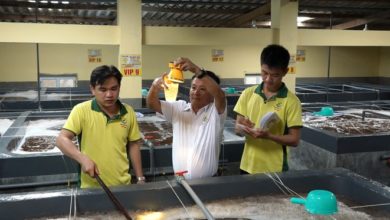
At a workshop held on 19 December in Cua Ong ward, provincial authorities, technical experts and shrimp farmers gathered to discuss pathways toward sustainable shrimp farming. While the event addressed practical farming challenges, its central message was strategic: science and technology must become the foundation of shrimp production if the sector is to remain viable.
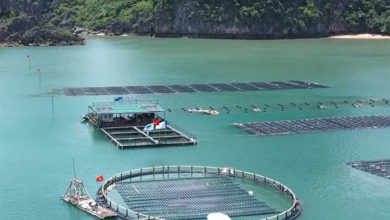
Quang Ninh holds strong natural advantages, including more than 250 km of coastline, around 43,000 hectares of mangroves and tidal flats, and a diverse coastal ecosystem. Yet recent years have highlighted the limits of relying on natural conditions alone. Extreme weather events, coupled with persistent disease threats such as acute hepatopancreatic necrosis disease (AHPND), white spot syndrome and Enterocytozoon hepatopenaei (EHP), have increasingly undermined farm performance and profitability.
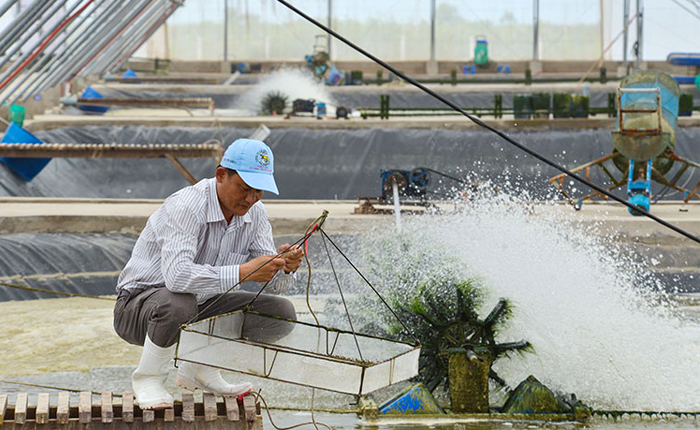
According to Nguyen Ba Lam, deputy director of the Quang Ninh Centre for Agricultural Extension and Forest Protection and Development Management, production models based largely on experience and limited environmental control are no longer viable. “Sustainable shrimp farming requires farmers to actively apply science and technology, managing everything from seed quality and pond conditions to disease prevention in a systematic way,” he said.
From technology adoption to mindset change
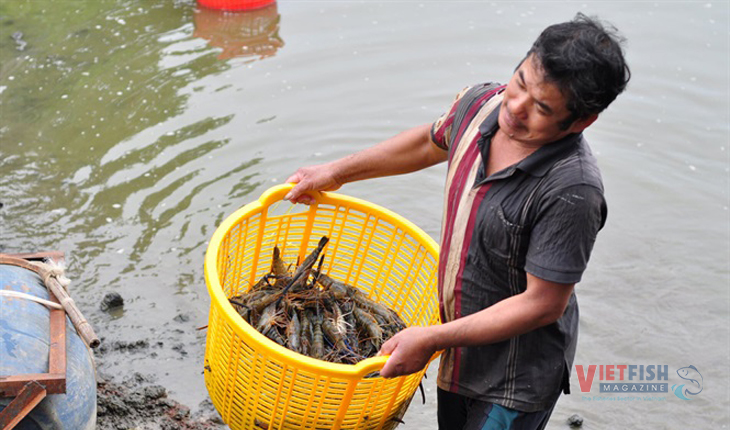
Over the 2021–2025 period, Quang Ninh has accelerated efforts to embed science and technology into shrimp farming, shifting its extension services from theory-heavy training to hands-on, field-based support. In total, around 50 training courses have been delivered to more than 600 farming households, alongside direct technical assistance to address over 500 pond environment incidents.
Key areas of focus include multi-phase production systems, such as two-stage and three-stage farming, the replacement of antibiotics with probiotics, and improved feed and water quality management using monitoring equipment. Several high-tech models, particularly biofloc-based systems, have shown tangible results, with reported profit gains exceeding 25 percent compared with conventional practices.
Beyond individual farms, technology has also been integrated into sector-wide management. Environmental monitoring programmes now collect close to 10,000 samples annually, enabling early warnings of unfavourable conditions and reducing the likelihood of sudden production losses. Meanwhile, investments in concentrated farming zones and high-tech agricultural areas, notably in Hai Lang and Dam Ha, are creating the physical and institutional framework needed to scale up technology-driven shrimp production.
For provincial authorities, the goal extends beyond deploying new equipment or protocols. “The real value of science and technology lies in changing how farmers think,” Lam said. “When decisions are based on data, technical standards and scientific guidance, disease prevention becomes far more effective than reactive treatment.”
Disease management remains the critical test
While farming technologies can improve efficiency, disease management remains the decisive factor for sustainability. Vuong Van Oanh, deputy head of the provincial Sub-Department of Livestock Production and Animal Health, said that in 2025 the total shrimp farming area affected by disease fell to 35.57 hectares, a sharp decline from the previous year.
However, the disease profile is shifting. EHP now accounts for the largest affected area, causing indirect economic losses through slow growth and poor feed conversion rather than mass mortality. “EHP is particularly challenging because it is difficult to detect without systematic monitoring and science-based management,” Oanh noted.
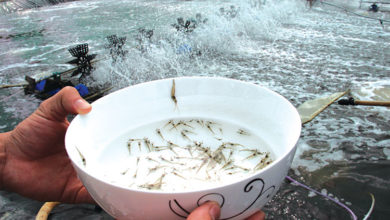
In response, authorities are urging farmers to strengthen biosecurity from the outset of each production cycle, use certified disease-free post-larvae, comply strictly with aquatic animal health regulations and avoid unapproved or human medicines. Greater emphasis is also being placed on record-keeping and traceability to support early intervention.
Policy measures are reinforcing these technical efforts. Under provincial Resolution 61 and Resolution 84, farmers can access financial support of up to VND 50 million per hectare for industrial shrimp farming when disease outbreaks occur. Beyond compensation, the schemes are designed to encourage compliance with standardised production protocols and transparent disease reporting.
A long-term strategy for competitiveness
Taken together, Quang Ninh’s approach reflects a broader shift in Vietnam’s shrimp sector toward proactive risk management. Science and technology are being positioned as a defensive system that spans spatial planning, infrastructure development, farming technologies, environmental monitoring and animal health governance.
According to provincial planners, Quang Ninh’s master plan for 2021-2030, with a vision to 2050, allocates more than 50,000 hectares for aquaculture, including around 7,500 hectares dedicated to shrimp farming. Concentrating production in well-managed zones is expected to improve environmental control while limiting disease spillover.
Rather than a short-term response to mounting pressures, the strategy signals a long-term commitment to competitiveness, environmental stewardship and farmer livelihoods. As disease risks and climate uncertainty continue to reshape global shrimp farming, Quang Ninh’s science-led model may offer a blueprint for how regional producers can adapt without sacrificing sustainability.
VFM