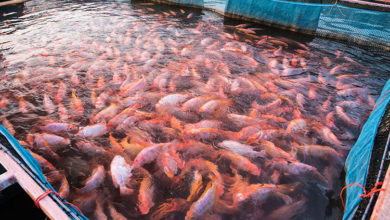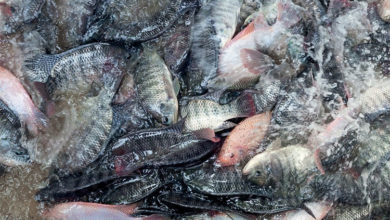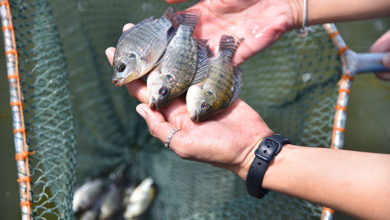

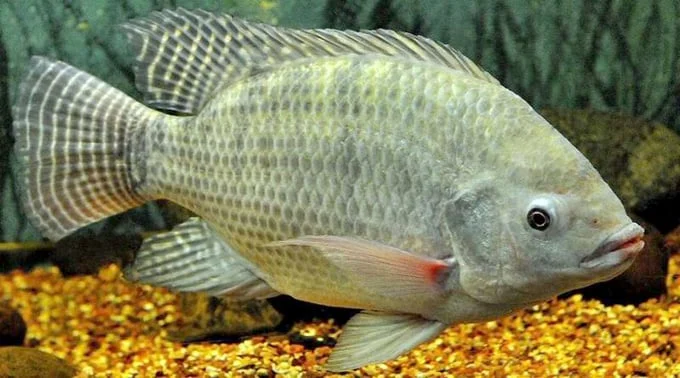
Hai Phong city is positioning all-male tilapia as a key species in its aquaculture restructuring strategy, with a growing number of high-tech farming models achieving yields of over 20 tonnes per hectare. These results are reinforcing the city’s ambition to become a major tilapia production and supply centre in northern Vietnam.
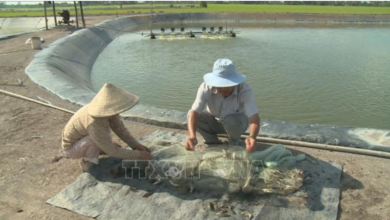
At an export-oriented tilapia farming model operated by Viet Nhat Nutrition Technology JSC on the outskirts of Hai Phong, large HDPE-lined ponds are managed as a closed-loop production system. Continuous aeration maintains water quality, while automated feeding systems are used in combination with company-formulated diets. All harvested fish are purchased under contract by the company, providing farmers with a guaranteed outlet.
According to Nguyen Van Ngoc, deputy general director of Viet Nhat, the company’s export tilapia project was launched in 2024 and has expanded rapidly. He noted that tilapia seed supply in northern Vietnam has traditionally been fragmented and inconsistent in quality, creating barriers to large-scale production. To address this, the company has partnered with Chinese suppliers to secure high-quality fingerlings and establish stable export channels for linked farming areas.
Hai Phong currently has around 5,000 hectares of tilapia farming area, accounting for more than 20 percent of the city’s total aquaculture area. Intensive farming systems, VietGAP-certified farms and Biofloc-based models have delivered strong productivity, with some sites exceeding 20 tonnes per hectare. The city is supported by 31 hatcheries, producing an estimated 330 million tilapia fingerlings annually, providing a solid foundation for further expansion.
Several cooperatives have also invested in processing to extend the value chain. Le Van Viet, director of Xuyen Viet Production and Trading Cooperative, said that processing has helped stabilise market access while increasing product value. The cooperative has developed a range of value-added products, including smoked tilapia, sausages and salted products, with the aim of repositioning tilapia as a versatile protein similar to poultry or pork.
Despite strong international demand for tilapia fillets, domestic consumption in Vietnam remains limited, with tilapia still perceived as a low-value freshwater fish. Do Duc Thinh, deputy head of Hai Phong’s Sub-department of Fisheries, Livestock and Animal Health, said that low farmgate prices have made farmers cautious about scaling up production.
He stressed that for tilapia to become a true flagship species, coordinated measures are needed, including securing high-quality seed supply, improving farming standards, expanding processing capacity, building branding and developing stable markets. With its port infrastructure and supportive policies, Hai Phong has set a target of becoming northern Vietnam’s tilapia production and processing hub by 2030, focusing on high-tech farming zones, traceability systems and integrated value chains aimed at both domestic and export markets.
VFM