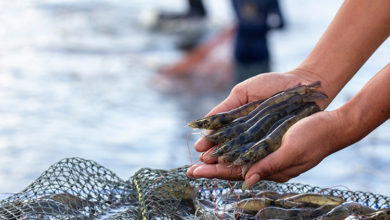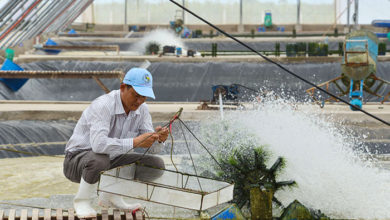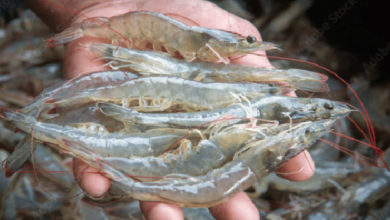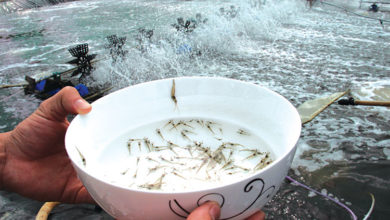

Amid high input costs and mounting environmental risks, brackish water shrimp farmers in Vietnam’s Mekong Delta are tightening production control, moderating stocking densities and adopting targeted technologies to safeguard margins and reduce disease and climate-related losses.
Risk management through operational flexibility
In Can Tho City, restructuring has become a necessity rather than a choice. Some producers have trimmed stocking densities, postponed pond upgrades or shifted to lower-cost inputs. Yet industry observers caution that indiscriminate cost-cutting can backfire, increasing the likelihood of disease outbreaks and water quality deterioration over the culture cycle.
Huynh Tan Luc, farming in Nguyen Ut hamlet, Khanh Hoa ward, has converted his earthen ponds by lining embankments while retaining natural pond bottoms – a hybrid approach that enhances environmental control without fully abandoning traditional systems. Lined pond banks reduce sludge accumulation, improve water circulation and limit pathogen build-up. Each crop begins with rigorous pond preparation, including dike reinforcement, sediment treatment and comprehensive testing of incoming water sources.
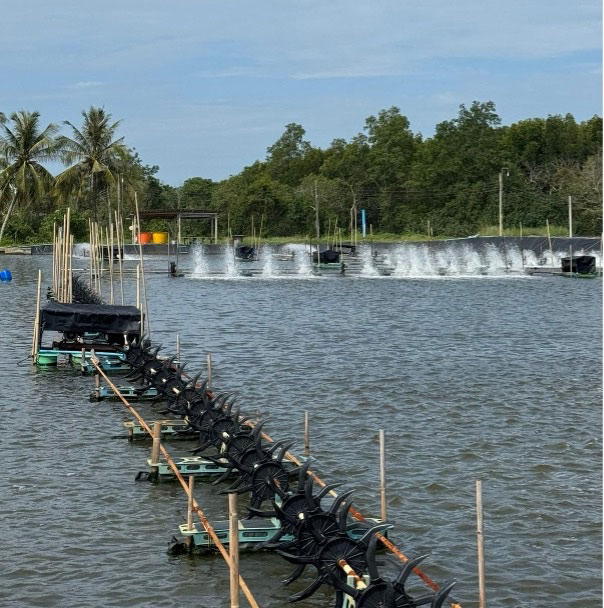
Elsewhere, farmers are deploying phased stocking strategies to manage uncertainty. Pham Huynh Ha in Bung Tum starts each season with a single pond, monitoring weather variability and market signals before scaling up. During the first 30 days, he closely tracks salinity, pH, alkalinity and temperature, removes trash fish and introduces post-larvae only when water parameters stabilise. Mineral supplementation and algae density management continue throughout the grow-out phase to sustain pond balance.
Ngo Thanh Tuan in Cang Buoi hamlet has reduced stocking density to approximately 100 shrimp per square metre to ease environmental pressure and curb toxic gas accumulation. During the rainy season, when salinity and temperature fluctuate sharply, he adjusts feeding regimes to minimise waste and prevent organic overload.
Collective action is also playing a role. The 14/10 Agriculture–Fisheries Cooperative in Hoa Tu commune, managing more than 31 hectares of ponds, has adopted a “slow but steady” approach. Only half of its area has been stocked so far this season, with staggered release schedules aligned to transitional weather windows. Harmonised environmental management protocols among members have helped contain losses and improve crop stability.
Technology adoption underpins sustainable growth
According to the Can Tho Department of Agriculture and Environment, brackish water shrimp remain a flagship commodity, covering around 52,490 hectares. In 2026, the city targets 51,000 hectares of stocked area and output of 240,000 tonnes. However, elevated feed and input costs, combined with farmgate prices that have yet to fully rebound, continue to compress profitability.
In 2025, more than 1,400 hectares were affected by production losses, underscoring the sector’s exposure to environmental stress and disease. Quach Thi Thanh Binh, deputy director of the department, stressed that adaptive feeding and water management are critical. During heavy rainfall or when temperatures fall below 24°C or exceed 32°C, farmers are advised to cut feed by 30 to 50 percent – or temporarily suspend feeding – to reduce organic loading. Supplementation with minerals and vitamin C can enhance shrimp resilience, while intensified environmental monitoring provides timely alerts to farming zones.
Research institutions are complementing these management measures with applied innovation. At Can Tho University’s College of Aquaculture and Fisheries, scientists are trialling a non-woven “Slim White Curtain” shading net designed to reflect infrared radiation without trapping heat. The material helps stabilise pond temperatures and improve culture conditions. Trials in 40 cubic metre systems achieved survival rates of 91.2 percent and yields of approximately 2.63 kg per cubic metre, outperforming unshaded ponds and those using conventional netting. Harvested shrimp also showed improved colouration, increasing market appeal.
Super-intensive Pacific white shrimp production in closed recirculating systems integrated with multi-species components is delivering further gains. Associate Professor Le Quoc Viet reported that these systems operate with zero water exchange during the crop, requiring only 10 to 20 percent top-up water and enabling reuse across multiple cycles annually. Experiments incorporating pumpkin as a supplementary feed ingredient have reduced nutrient discharge due to its lower protein content compared with commercial pellets, while maintaining growth performance. Shrimp produced under this regime exhibit firmer texture, brighter colour and command stronger prices.
From individual households to cooperatives and research institutions, adaptive management combined with science-led innovation is reinforcing the Mekong Delta’s shrimp industry. While market recovery remains uneven, the sector’s proactive shift towards controlled production and technology-driven efficiency is positioning it to sustain long-term growth despite continued environmental and economic uncertainty.
VFM