
France backs Vietnam’s push for zero-waste shrimp farming
A France–Vietnam aquaculture initiative is helping transform the Mekong Delta’s shrimp sector through circular production models that cut costs, reduce waste, and create new value chains.

Launched in 2023, the 3R4CSA project, funded by the Solidarity Fund for Innovative Projects (FSPI) under France’s Ministry for Europe and Foreign Affairs, promotes climate-smart, zero-discharge aquaculture in Vietnam. The initiative is coordinated by CIRAD, in partnership with IRD, INRAE, Can Tho University, RIA2, and the Foreign Trade University.
Circular model reduces costs, increases profitability
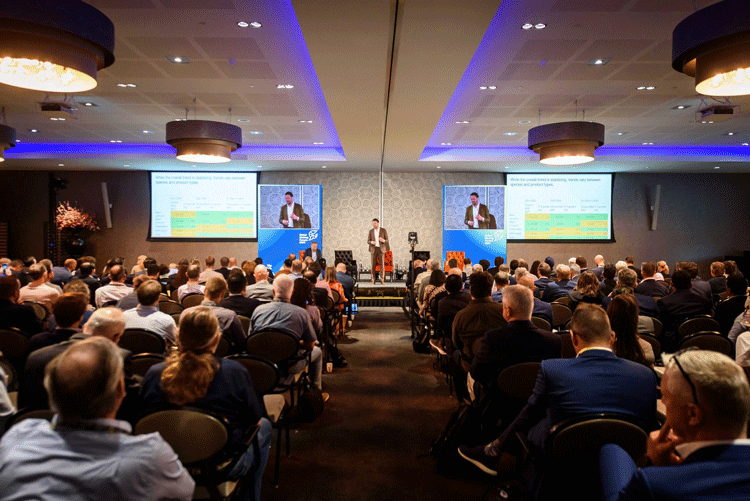
Speaking at the project’s wrap-up event on July 31, French Ambassador to Vietnam Olivier Brochet said:
“The 3R4CSA project embodies the France–Vietnam Strategic Partnership. It demonstrates that ecological transition in aquaculture is both achievable and economically viable.”
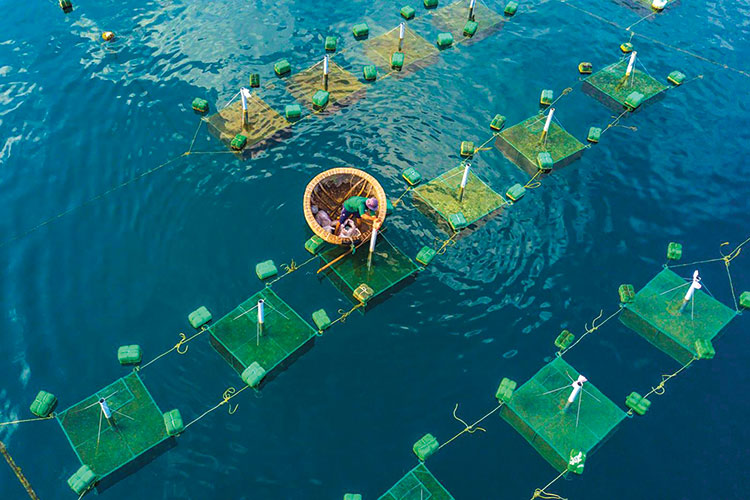
By piloting recirculating aquaculture systems (RAS) for intensive whiteleg shrimp farming, the project has achieved up to 90% water reuse while eliminating wastewater discharge. According to CIRAD researcher and project leader Dr. Kazi Kabir, circular feed solutions, derived from biotransformed aquaculture waste, can slash input costs by up to 50% and reduce reliance on imported feed ingredients, which currently account for 70% of production costs.
“The result is a potential 30% increase in farm profitability,” Kabir noted.
Expansion is underway. Two intensive shrimp systems have already been piloted, with plans to scale up to 100 hectares by end-2025 and reach 1,000 hectares in Ca Mau province by 2026–2027. An additional 1,000 hectares for extensive black tiger shrimp farming is also planned, alongside seaweed integration.
Seaweed and microalgae: New frontier for value chains
Seaweed cultivated alongside shrimp provides water temperature regulation and natural disease resistance. The project is now moving into nutrient-based production of microalgae, currently commanding three times the market value of seaweed.
“Seaweed and microalgae offer enormous potential,” Kabir said. “They support both carbon sequestration and product diversification, aligning with Vietnam’s green export strategy.”
Empowering smallholders and women in aquaculture
While shrimp farming remains capital-intensive, the project has helped diversify into secondary value chains more accessible to smallholders, such as tilapia, seaweed, and other finfish. It has also created new roles for women in waste recycling and nutrient recovery.
Fewer than 15% of women in the Mekong Delta currently participate in aquaculture technical work, according to 3R4CSA research.
“We’re seeing small and medium enterprises step into circular aquaculture through low-barrier technologies,” Kabir said. “That includes more inclusive opportunities for women and vulnerable communities.”
Kabir also pointed to shifting dynamics in the global seafood market. China, which accounts for up to 70% of global aquaculture production, is expected to reduce output by 5% by 2030 to meet environmental targets.
“This opens space for producers like Vietnam, Indonesia, India, and Bangladesh to grow exports,” he said.
The project directly supports Vietnam’s national strategy for circular economic development and climate action under the Paris Agreement. Dr. Nguyen Nhut of RIA2 emphasized the model’s potential:
“We’re not only reducing environmental pressure, we’re gaining a competitive edge. Sustainable shrimp and seaweed production can position Vietnam as a global leader in green aquaculture.”
VFM